Sunday, April 5, 2015

Easter Sunday and the 60-cent Trio Book

Beautiful Harmony  - No Matter How It Is Done
                As soon as my father arrived home from his rehabilitation stint following his first stroke in 2012, we began having what my mother refers to as “church.” It consists of reading a devotional, the accompanying Bible passage, a prayer, and singing two or three hymns. Until Dad’s second stroke in April of 2014, the three of us sang. Dad can no longer sing so Mother and I do the singing. Usually, she adds harmony. When Angie stays overnight, we sing three-part harmony.
                The last time Angie stayed and sang, she mentioned, “I sing harmony by note.” Just a day earlier, Mother had commented that she sang harmony by “feeling it.” Actually, Mother‘s experience and innate musical talent enable her to say this. Since I love singing harmony, these comments set me off on a search for some music for Angie to “read” and sing the next time she came to the farm overnight. I pulled a well-worn harmony book entitled Sacred Trios for Sopranos and Altos from the music shelves above my piano. Upon seeing it, my mother began reminiscing.
                Mother used that choral book first with girls in her Sunday School class at the Masham Baptist Church. I flipped to the song “Were You There?” which three of the girls had sung for Easter well over fifty years ago. Most of the young ladies in her Sunday School class sang in the Pawnee High School Glee Club. (These girls had more experience than the little elementary-age ones she had taught at Belford Grade School in the Big Bend community. See the blog post entitled at this link: https://bernadeanjgates.blogspot.com/2014/11/when-little-brown-eyed-durgan-lived.html)
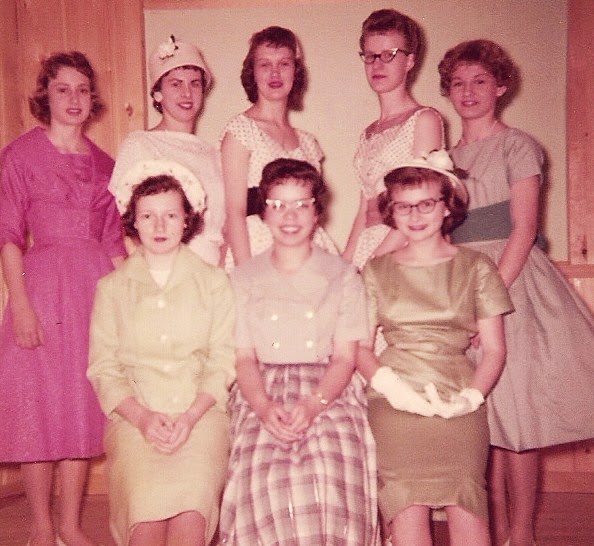
The Masham Girls in the Early 1960s - Back Row - Linda Bright, Sue Schultz, Mary Jo Thurber,
Norma Nell Wheatley, and Frankie Wills. Front Row - Elaine Wills, Nancy Leforce, and Vickie
Wills. My mother took this on an Easter Sunday morning at the Masham Baptist Church.
                She reminded me that Peggy Barnes, Sue Shultz, and Norma Nell Wheatley came to our home to practice that Easter Sunday trio special.* Surprisingly,  I recall more succinctly a practice at the Masham Baptist Church. The close harmony of those teenage girls, who were my idols at the time, mesmerized me as a little preschooler sitting quietly in a pew by myself,
                My mother retains cherished memories of those girls in her Sunday School class over 50 years ago. Anytime she gets to visit with those women proves to be filled with joyful recollections as well as updates on their own children and grandchildren. Her heart goes out to them when they suffer illness or loss in their families. She grieved over several of the “girls” from her class who have already died.
                She hardly ever discusses the “Masham girls” without bringing up their present faithfulness in their churches. She may mention how they have raised their children according to the principles of God’s Word, reaping multiple benefits. One of her former students mentioned in her 2014 Christmas card of her husband’s serious health issues. Each evening we lift her and her husband up in prayer.
                One of my favorite verses is the last one in most versions of Were You There. The words prepare us perfectly for a genuine Easter celebration.
Were you there when He rose up from the dead?
Oh! Sometimes I feel like shouting glory, glory, glory,
Were you there when He rose up from the dead?
                                                                                                                                                                                              Public Domain
                So many times I sing the third line with a memory of Dad. Frequently, Dad would come into the house to share a blessing he had experienced on the farm or we would share some good thing that had happened to us. Instantly, he would throw both hands in the air as though the Woodland Cougars had just scored, and exclaim, “Glory!” That’s how we should celebrate the resurrection of Jesus  - not just on Easter Sunday, but every day of the week. He alone is worthy of our praise and the beautiful harmony of lives lived for Him. That same sweet harmony can then permeate all our relationships to the glory of Him.
               
*A later trio of girls that sang in the Masham Baptist Church was composed of Nancy and Janie Leforce along with Linda Laird. 
The Trio Songbook published in 1945 and sold for $0.60.
My sister, Angie Gates Bradley, Barbara Rice, Sharon
Stewart,and I sang at least one song from this classic
treasury of trio arrangements for female voices. It remains
one of my favorite publications for a trio of voices.

Sunday, March 29, 2015

Reflecting on the Willing Sacrifice of Good Friday

As I have been writing this blog post, a passage from C.S. Lewis’s The Lion, the Witch, and the Wardrobe (Scholastic, 1987) has continued to pervade my thoughts so it seemed it should have a place in the posting. Aslan described the significance of  his murder by the White Witch and his miraculous resurrection from death. He explained eloquently the power of the moment, allegorically reminiscent of the crucifixion of Christ. Aslan said, "She would have known that when a willing victim who had committed no treachery was killed in a traitor's stead, the table would crack and Death itself would start working backward."

The Bottle-fed White Calf and Good Friday
                On February 3rd, Dad’s white-tail cow had a little white bull calf. Within a few days, it became apparent that the baby bull calf was not thriving. My brother-in-law and sister made an emergency visit to the farm. Ben loaded the calf in the back of his pickup. Angie, my sister, drove them up to the house. They brought calf milk replacement that Mother used to prepare a bottle. The little white calf began devouring the milk from the bottle, eagerly following Ben and looking for more. I assumed the responsibility of feeding the calf at least twice daily.  
                Soon I had to admit that I could not adequately care for Dad and the calf. After a week of nurturing the little white bull calf, we arranged to sell the calf and his mother. My cousin, Tim came to haul the two to the weekly livestock sale. Ben carried the calf into the trailer. I stood beside the trailer near its front. The calf began to suckle my glove on that cool February morning. Soon the calf's mother was loaded into the trailer, too.
                As I walked to the house, waving to Tim as he pulled the trailer onto the road, I reflected on the happenings of the morning. The tiny, innocent-appearing calf stood motionless in the trailer, not making even the slightest sound. Then my mind shifted to recall a passage in Isaiah 53:7 in which Isaiah predicts the sacrificial death of Jesus.
He was oppressed and afflicted, yet He did not open His mouth;
He was led like a lamb to the slaughter,
And as a sheep before its shearers is silent, so He did not open His mouth. (NIV)

                The little white calf stayed so willingly in the trailer. In comparison, Jesus, out of love for us,willingly endured the shame and death of the cross for our sins, taking the punishment on His perfect self. Paul described, with poignancy, Jesus' atonement in his letter to the church at Corinth when he penned:
God made Him who had no sin to be sin for us,
So that in Him we might become the righteousness of God. (NIV)

                As we enter the week preceding Good Friday and Easter, may we take time to reflect on our unworthy sinfulness in contrast to His perfect willingness to take our place as the only way to free us from our detrimental transgressions. Only the Lamb of God who takes away the sin of the world (John records this assessment by John the Baptist of Jesus in John 1:29.) could restore life as it was meant to be for humans. Let the little white calf nuzzling so willingly my gloved hand serve as a visual reminder of the precious death of Jesus motivated only by His love for the unloving to make them right with God. Throughout the week, may we, who have been forgiven and freed from the guilt and power of sin, offer heartfelt thanks and gratitude to the only One who could provide such freedom - Jesus the Savior of the World.
The little white calf explores the hay after taking his evening bottle.

Sunday, March 22, 2015

The Theater Manager Who Married a Rainey Girl

This week will mark the 128th birthday of William John Buckley, the husband of Emma Maryann Rainey Buckley. Ironically, next Sunday will be 70 years since his untimely death. My mother retains vivid, cherished memories of the five years of her childhood when she had her Uncle Bill in her life.

William John Buckley
William John Buckley was born in Montgomery, Alabama, on March 23, 1887. By the age of 13, "Willie" was at Sapulpa in the Creek Nation, Indian Territory, as recorded in the 1900 census.
“Bill” Buckley was the son of Sarah and John M. Buckley, a prominent family in early day Pawhuska. Bill’s father was the city engineer of Pawhuska, Oklahoma, in the early 1900s. In the publication, The Contractor published in Chicago, in the issue dated September 15, 1916, tells of Mr. Buckley’s plan to construct the 510-foot bridge over the creek in City Park in Pawhuska at the cost of $350,000. I recall going over a bridge in Pawhuska as Mother made the comment, “Mr. Buckley constructed this bridge.”
              William J. Buckley was discharged as a private serving in the Coastal Artillery Company based in Fort DuPont, Delaware, on November 29, 1918. He had enlisted on July 31, 1918. At the time of his enlistment, he listed his occupation as a moving picture operator. 
Bill had no interest in civil engineering as his father did. Instead, he was fascinated with the new technology of the moving picture. This catapulted him into managing theaters for the Griffith Brothers*.  While in Fairfax, Oklahoma, when he was the manager of the Tall Chief Theater, he met my maternal grandmother’s sister, Emma Maryann Rainey. Aunt Emma was always the sophisticated sister. Bill Buckley was quite “taken” immediately with Emma.. (A photograph of Emma as a child appears in the blog post entitled Alice Rainey- The Valentine Baby that published on February 9, 2014. To see her in a stately pose, access The Bittersweet Shared Birthday that posted on August 10, 2014.) 
William John Buckley married Emma Maryann Rainey on January 20, 1929, when he was 41 years old and Aunt Emma, my grandma’s youngest sister, was 25 years old. As my mother says, “Uncle Bill doted on Aunt Emma.” He provided for her anything she wanted. As some would say, while she was married to him she led a charmed life.
They lived in Fairfax during the time he managed the Tall Chief Theater. Aunt Emma and her new husband enjoyed being a part of the social life of the early 1930s, being a part of a group of couples who relished playing bridge.
My grandmother, Gladys Vivian Rainey Smith, preserved a newspaper article praising the creative side of her brother-in-law. Bill’s hobby of constructing an eight-tube radio receiver set. The article lauded his success of being able to hear stations from both the Atlantic and Pacific coasts with clarity on the “bear cat” machine he had built. The newspaper reporter marveled that Uncle Bill’s “knock-out” set was small enough to fit into a suitcase!
Within a couple of years, Bill Buckley was promoted to manage The Lyric Theater in Vinita, Oklahoma. Bill and Emma moved and continued to live their dream life full of love, laughter, and friends. Mother has a copy of a letter dated January 22, 1934, that was addressed to "Bill" from J. H. Griffin concerning negotiations on another theater in Vinita.
              This time of happiness and success was cut short by his brief illness and subsequent death. Bill contracted pneumonia and being a heavy smoker could not overcome the disease. Within a week, he was dead on March 29, 1934. Mother recalls, to this day at age 90, the location of his burial in the Pawhuska Cemetery. He was only 47 years old. Mother was nine years old when one of her favorite uncles died suddenly.
            After being married for only five years to the love of her life, Aunt Emma suffered an emotional collapse, my mother recalls. She lost all desire to go on and for approximately a year, she mourned his death, seeing no future for herself, as she battled severe depression. I recall my grandmother telling me  that one morning Aunt Emma got out of bed and ran out into the field. It was as if she had gained a new lease on life. She moved into a new chapter of her life, but without the man who had provided comfortably for her with his rock-solid stability motivated by adoring love.

*Deborah A. Carmichael's dissertation written in 1969 to fulfill her doctorial requirements at Oklahoma State University entitled The Griffith Brothers Circuits of Oklahoma: Film Exhibition Success Outside the Hollywood Studio System can be read online at:  https://shareok.org/bitstream/handle/11244/7058/English%20Department_09.pdf?sequence=1


"Bill" Buckley with his beloved dog, Bing.
Additional note: I have never seen a photograph of Bill and Aunt Emma together. However, as I grew up, Bill Buckley's World War I photograph was on display in our home. When I was in college, my grandmother offered the photograph to Aunt Emma again and much to Grandma's surprise, she took it. Evidently, after around 40 years, Aunt Emma was able to deal with his death and the memories of their five years of marriage. His photograph on display once more reminded her of those few years with the man whose strength and love loomed so large that she would never remarry.