Sunday, March 26, 2023

Remembering Nelda

   This Wednesday, March 29 will mark seven years since Nelda Shafer's death. So many people were touched by her life, her laughter, her loving ways and her love for the Lord. May we make our own little part of the world a better place by every day carrying on her legacy                          

She Was Bigger Than Life

                I met Nelda June Shafer upon being hired to teach at Marlin Crowder Elementary in Fairfax, Oklahoma, in the fall of 1979. Nelda exuded a warmth and friendliness, but there was so much more to her.
                Soon I would learn from my mother of the time Nelda spent in the Big Bend as a child, attending Belford Grade School. Mother extolled the godly character of Nelda’s mother, Rhoda McKinney, as well as Nelda’s grandmother, Mrs. Knight.
                Nelda came to the field of education later in life than some of us. She brought a common-sense approach to education. Foundationally, she loved each student. She cared about the efforts made by each parent. Her compassion and endeavor to reach each student knew no bounds.
                Nelda loved to laugh. How often she orchestrated a practical joke, getting as many other faculty members involved as possible! It seemed her favorite targets were Woogie Adams and Burley Hathcoat. The retelling of her elaborate ruses brought as much laughter to Nelda and the rest of us as the initial incident itself had.
                Yet the strong inner part of Nelda made her who she was. In the spring of 1987, I observed this. I recall Sharon Stewart leaning over to me in the choir loft of the Ralston Baptist Church on Easter Sunday, inquiring if I had heard about Nelda’s daughter. What horror to learn she had been murdered!
                With music interwoven into every fiber of my being, the two of the musical selections chosen by Nelda for Sherri’s funeral service remain indelible in my memory. One was the upbeat song entitled “Angels All Around Me.” “The Only Real Peace That I Have” was the other song. I glimpsed Nelda’s face during the song. Since I have such a sensitive psyche, I always try to never focus on faces, especially eyes, at a funeral. That empathetic part of me tends to “weep with those that weep.” Even though I knew Nelda experienced heart-wrenching grief, she had a persona of peace as the song stated because, “the only real peace that we have, dear Lord, is in You.” *        
                Many years later, Nelda and I were required to attend a training. I don’t recall what we were learning or where we drove to learn it. I do remember Nelda was driving. She and I tended to discuss deep or serious issues often when we had a conversation.
                Somehow her Melanie emerged as the topic. I may have asked a few questions, but primarily, I just listened. Nelda told of how she was alone in Oklahoma City when the doctor told her all efforts to allay the ravaging disease wreaking devastation on Melanie’s young body had been exhausted. Nothing more could be done. Nelda had to find her way home to Fairfax. She indicated she had no idea how she drove the two hours for miles and miles. I’m sure she had God’s angels all around her.
                Many times, I have drawn strength from Nelda’s experience in life. Each difficulty she handled with serene grace, a strong faith that God could act on her behalf, and the solid trust that the God who had seen her through so many adversities and trials would see her through whatever the present one was.
                 I remember dropping by to check on her when Shafe, her husband, was gravely ill. We visited a bit and I offered to pray with her. She said, "Just pray he can live until his birthday." We clasped hands and requested that God preserve Shafe's life until his birthday. He left this earthly life two days after his 89th birthday.
                Hopefully, as we mark the seventh year since her death, we will recall and retell the hilarious stories that she so loved. (I can hear her distinct laugh as I write this.) She would like that. Most of all, she would want each of her former students, each of her relatives, every parent that she encouraged, and each person she called “friend” to be assured that their sins have been forgiven by Jesus and are living daily in the peace that reliance on Him can bring to lives leaning on Him.
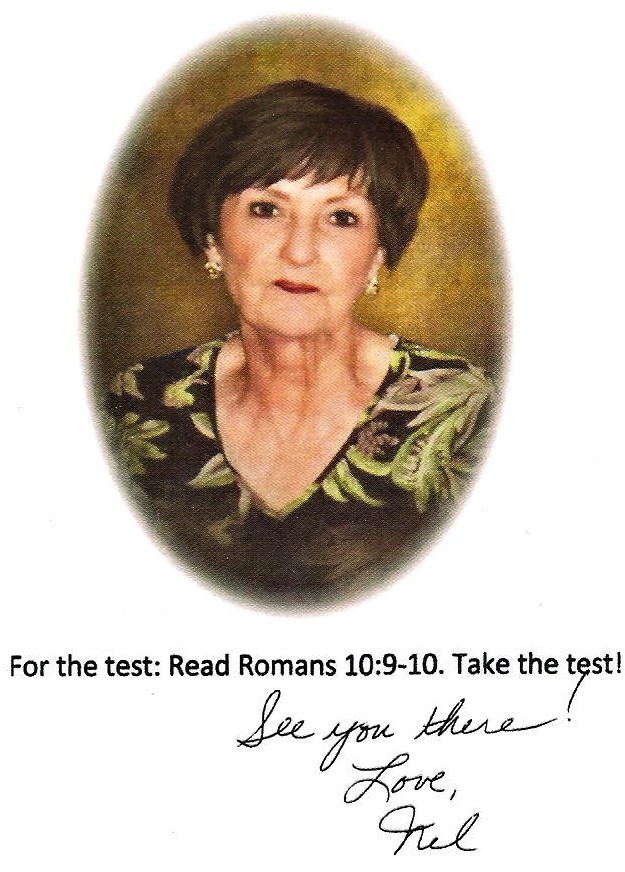
                Here final message, in her own distinctive handwriting, spoke to each of us from the folio distributed at her funeral. She gave the test preparation with the directive to “take the test.” Nelda desired for her students to succeed on every exam she gave. Her last one was no different. Here is the study sheet:
If you confess with your mouth the Lord Jesus and believe in your heart that God has raised Him from the dead, you will be saved. For with the heart one believes unto righteousness, and with the mouth confession is made unto salvation. Romans 10:9-10
                Genuine belief that Jesus is Lord (the Boss, yet never bossy) and was raised from the death of crucifixion must begin at the core of our being. When we embrace Jesus as Lord of our lives, we are given His righteousness and are not ashamed to confess Him as Lord – the One in charge. If we have truly accepted Jesus as our Lord then His leadership will be reflected in our lives. How much Nelda’s life reflected this! She studied God’s Word and prayed daily, stood for right even if it was unpopular. Her compassion and generosity touched so many of our lives.
                Have you passed her final test? Its results will determine whether you ever see this dynamic woman again. Passing Mrs. Shafer's final exam will enable you to stand tall in your own deep valleys because, like her, you will have Jesus walking beside you, giving you strength and encouragement.

*I listened to "The Only Real Peace" this week. Here is a link to it being sung by the composer's daughter, Candy Hemphill - https://www.youtube.com/watch?v=xNO9gXVy9zo


Sunday, March 19, 2023

The Influencers

       Much gratitude goes to Alan Yarborough and Sue Remick for these vintage photographs over a hundred years old. Alan and Sue are cousins who also descend from Cull-ca-yer (the spelling on his military record) and Rachel Kingfisher Smith. Thanks to both of them for sharing!

             March 13 marked 129 years since my maternal grandpa’s birth. Grandpa, Calvin Callcayah Smith, was born in the Cherokee Nation and named for his paternal grandfather, Cul-lah-ca Smith, who walked the Cherokee Trail of Tears with his mother and brother when little Cul-lah-ca (the spelling of his name on the 1851 Drennan Roll) was under ten years old.

              Cul Smith and his wife, Rachel Kingfisher Smith had four children – Walter, my great-grandfather, John, Josephine, and Elizabeth. Both parents were deceased by the time Walter was twelve. Family lore indicated these children orphaned directly by the Civil War’s incursion into the Cherokee Nation went to live with their maternal grandparents, the Kingfishers.

One of the few 
photos of Grandpa 
smiling.
           My grandpa highly regarded his aunts, Jo and Lizzie, as he referred to them. He never indicated that his father and siblings lost their parents violently when they were quite young.* In his few conversations about these beloved aunts, he highlighted how well educated they were.


Josephine Lee Smith West - given by 
Alan Yarborough, a grandson of Elizabeth
Purcell Hammer, Mother's cousin.
           Josephine Lee Smith West was born in 1860. According to family information from Elizabeth Purcell Hammer, Mother’s cousin, the Mayes County Historical Book had a section about Grandpa’s beloved Aunt Jo. “When Josephine was older, she was taken to Salina to enter the Cherokee Orphan Asylum, where she finished her schooling in 1880 at the age of 20.”

          Mabel Elizabeth Smith Wood Moore was born in 1862 making her the youngest of the children of Cul-lah-ca and Rachel Smith. According to her great-granddaughter, Sue Remick, Lizzie entered the Cherokee Orphan Asylum around 4 years old and lived there for some time. Sue located academic records showing that her great-grandmother was enrolled around the age of 10-11. She said there is a family story about Lizzie going to school and being sent home because she already had enough knowledge. Lizzie taught school in Rose, Oklahoma, in 1890, when she was 25 and already married.

Mabel Elizabeth Smith Wood Moore - photo
given by Sue Remick, her great 
granddaughter.

          The word “asylum” was used because it meant a “refuge, shelter, retreat” for the many Cherokee Civil War orphans or “half-orphans” (A half-orphan had lost one parent in the bloody conflict). The Cherokee leaders allotted money and used the palatial brick home built by Lewis Ross, the brother of Chief John Ross. Orchards, gardens, a cotton field, a cotton gin, a gristmill, and other farm buildings dotted the area for the much-valued Cherokee orphans. Only the gristmill still stands today.

          Grandpa held education in high esteem. Even though his own education was limited, even into his eighties, Grandpa voraciously read and studied, especially his Bible.

          His multi-lingual father spoke Cherokee, English, and Spanish. We have copies of Great-grandpa Walter’s writing in Cherokee and English.

          Grandpa insisted I would go to a “teachers college” and earn a degree. He usually cited the examples of his Aunt Jo and Aunt Lizzie. He was proud of his nieces, Elizabeth Purcell Hammer and Fern Purcell Anders, who were also educators earning their degrees on the beautiful campus of Northeastern State University at Tahlequah on the original site of the Cherokee National Women’s Seminary. 

          At the time, I would not consider education as a possible career since I observed students daily who seemed to have little desire to learn from the dedicated teachers. Never would I let Grandpa know, but I thought I was headed for a career in the medical field. I did not want to disappoint him.

          Maybe Grandpa watched me play “school” with Angie when she was only three years old. She focused so well that I could teach her much more than she supposedly was old enough to master.

          As a retired career teacher, I did fulfill Grandpa’s goal for me. Job asked in Job 12:12: Is not wisdom found among the aged? Does not long life bring understanding?

                May we be willing to share our experience with those younger - not imposing our opinion but listening and observing the younger ones with whom we are interacting. This activity is not instantaneous but requires time, patience, and building of a relationship, earning the right to be heard before sharing. Happy influencing for a lifetime in someone you love!

  *To learn more about my great grandfather and his family, go to this link  https://bernadeanjgates.blogspot.com/2016/05/its-more-than-first-holiday-of-summer.html

Sunday, March 12, 2023

Strength and Courage in the Face of Fear

The earliest photograph of Rosa Jarrell
 Rainey that I have seen.
  from my grandmother, Gladys Rainey
Smith's photograph album.

March is Women’s History Month. It is my hope that family stories of courage, strength, and perseverance amidst fear-filled, dangerous situations will propel us through our own 21st century storms and difficulties—especially those about the women from whom we descend. What a perfect time to honor Rosa Jarrell Rainey with a retelling of her courage and faith since we marked the 155th anniversary of her birth on March 7!

Crossing the Red River

                In the last half of the 19th century, rail travel was among the fastest modes of transportation. This booming industry could hardly construct railways quickly enough to meet the outcry for connecting the United States and its territories. The Chicago, Rock Island, and Pacific Railroad Company had begun construction of the railroad in the Chickasaw Nation in 1892.** They laid the tracks alongside the old Chisholm Trail that had been used by the cowpunchers for so many years during the cattle drives that culminated in Abilene, Kansas.

                William Marion Rainey and Thomas J. Rainey, his father, joined the force of sturdy, strong men laying the rails in Texas. William had married Rosa Jarrell Rainey in Bloomfield, Missouri, on December 19, 1889. While my great-grandfather and my great-great grandfather were working in Texas, Rosa, my great-grandmother, stayed busy cooking for the hardworking men on their crew. Amidst all the rigorous demands on this young couple, their first baby was born in Texas on September 30, 1893. They named her Daisy Dean.

                Then Bill Rainey, as so often happens today in the 21st century, followed the job opportunities. He crossed the Red River into Indian Territory, leaving his wife and baby daughter behind in Texas. In 1894, Rosa, pregnant with her second child, clutching Baby Daisy in her arms, crossed the Red River in a wagon. I recall my grandmother, Gladys Vivian Rainey Smith, telling me of her mother conveying vividly how challenging and frightening this ordeal was for her.

                What a brave 26-year-old she was! She most likely crossed at the traditional ford of the Chisholm Trail near Terral, Oklahoma. The National Weather Service’s hydrograph of the Red River near Terral shows a range from a low of 6 feet to 22 feet at flood stage for this crossing.

This marker was placed to mark the crossing by the
  Historical Society of Fleetwood
    Terral, Indian Territory (Oklahoma)    

              I think of the courage of my great-grandmother, reins in hand, traveling with her precious little baby. As she approached the Red River, tension gripped her muscles. The burden of responsibility for her baby girl, the team of horses, the wagon containing all their worldly goods, and her unborn child weighed heavily upon her. Rosa tried to steel herself to her worries and anxiety, hummed nervously a lullaby to Baby Daisy Dean, and plunged the team of horses pulling the wagon into the murky water. What relief she must have felt as the strong steeds pulled the wagon with all her family’s belongings onto the Indian Territory side of the riverbank!

               On December 10, later in the year, Rosa gave birth to Lewis Elbert Rainey, her first son, in Terral, Indian Territory. The newly formed railroad town was only a couple of years old. According to my grandmother’s personal, handwritten family records, it was while Rosa and Bill were living in Terral that the two of them were converted and then baptized by Reverend Parker.

              In light of this information, my heart goes out to that frightened, young ancestor of mine, who had not yet experienced the peace that Jesus brings when our lives are committed to him. Great-grandma Rosa didn’t yet have a relationship with the heavenly Father to whom she could pray and ask for strength and safety as she forded the Red River with tiny Daisy. Possibly the paralyzing anxiety and debilitating helplessness she experienced as the horses splashed through the muddy water, straining to draw the heavy wagon onto the dry ground caused Great-grandma Rosa to begin to realize she needed strength beyond her own ability. Later when she heard Reverend Parker’s sermon in July of 1896, she and my great-grandpa responded to God’s work in their hearts. 

            It is my prayer that those of us who descend from this couple will be sensitive to God’s quiet work in our lives and affirm our need, commit our lives to Jesus, and then follow Him daily. From the many stories my mother has told of her dearly loved Grandma Rainey and her faith, I am reminded of the words John the Apostle wrote in his third letter, verse four. These would convey her desire for those of us who descended from her.

I have no greater joy than to hear that my children walk in truth.

*    http://www.blogoklahoma.us/place.aspx?id=608

**  http://digital.library.okstate.edu/encyclopedia/entries/J/JE002.html